


I – Context Behind the Allegory and Popular Interpretations
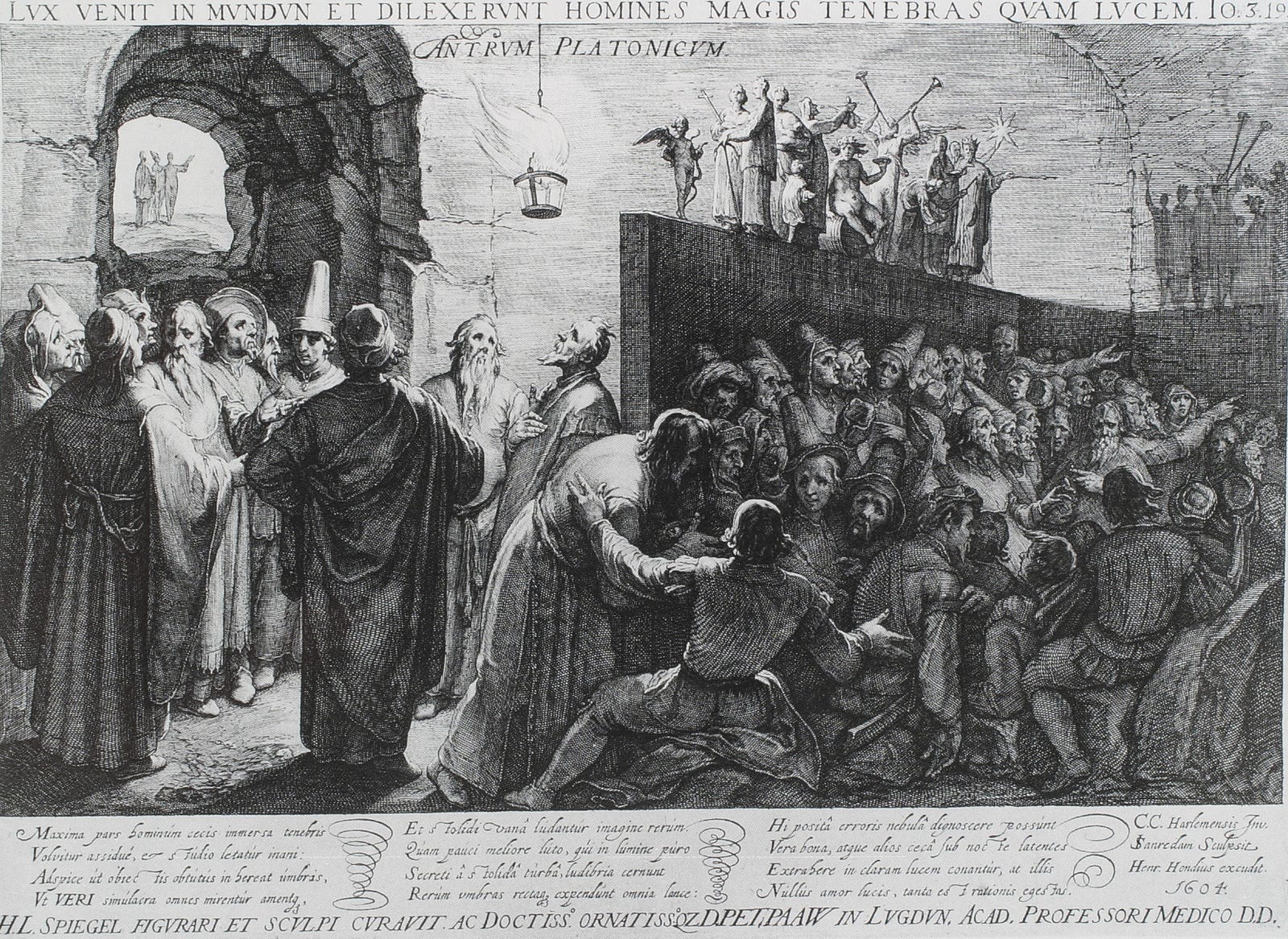
Plato’s famous Allegory of the Cave rests at the beginning of Book VII of the Republic. It follows the
analogies of the Sun and the Dividing Line, two somewhat less famous images on knowledge and understanding. Perhaps the most famous allegory of ancient philosophy directly follows, building on these images of light and division. In this case, the allegory is offered as an explanation of the effect of education.
A rather compelling image is of an individual forcing one of the prisoners up from his chains, dragging him up the steep climb out of the cave, and being shown the light in a way that is painful and disorienting. The former prisoner, now freed against his will, is blinded by the light from outside of the cave. What purpose does this image serve?
A common interpretation is that one has been compelled – by reason, fate, education, or some other higher principle – to see the “truth” that others simply have not. Unfortunately, many fall into the temptation to see themselves as the “escapee” who has “seen the light”, while others who disagree with them are the foolish prisoners. Of course, they equally identify their struggle with perceived error as their own philosophical “martyrdom”, as the “escapee” experienced in the allegory. Those who parade about with the figures and casting shadows are often identified with governments, religions, and all sorts of institutions.
The popular appeal of this reading is deeply understandable. It is quite flattering of the reader! Insight is virtuous, disagreement is ignorance! Intellectual discomfort can be turned into moral drama. This is very much the impression I left with in the tenth grade. While this reading is certainly licensed given the context, I’ve often reflected on an alternative reading that has aided me greatly in my own pursuits.
II – Orientation, Rather Than Interpretation
The reflection below is not a claim about Plato’s authorial intent, a doctrinal thesis on Socrates or Platonism, or an assertion of historical accuracy. The Allegory has been discussed, interpreted, and debated for over two-thousand years and in nearly every American high school history or literature class. Rather than making a claim about how one should read this allegory, I offer this interlude as something more simple: a novel approach aiming at self-application rather than a theory of knowledge or enlightenment. This is an explanation of my own philosophical practice driven by my personal experience, philosophical anxieties, and desire for truth. For purposes of explaining this method of philosophical discipline, I am bracketing questions of authorial or philosophical intent.
III – The Allegory, Internalized
Imagine, if you will, that every figure in the Cave is present simultaneously within the same person. At any given time, we are both captive and jailer, prisoner and rescuer, and the one fooling and being fooled. At any time, we can offer ourselves many philosophical temptations: premature closure, the appearance of intelligence and depth, and the rationalization of the weaker argument that fits better with our current biases rather than the stronger that may destabilize us.
This interior “cave” is continuously inhabited. When one avoids self-deception, we are the ones leading the escape. When one fails to apply rigor, we are the prisoner. When we suppress a moment of insight and instability in spite of the stronger argument, we parade with the shadow-casting figures in front of ourselves.
A deep temptation of mine is when inquiry turns back inward. Perhaps a provisional definition is faulty, and I sense it. A temptation arises to reinterpret a question, rather than revising one that relies on a false assumption. Perhaps seeing an interlocutor return to a deeply-held commitment moves me to remember the very same things I had not yet questioned. In that moment, I can be the escapee, guiding myself towards further questioning, or the prisoners who kill the escapee for ruining the illusion of intelligence and sophistication.
We also repeatedly ascend and descend – not to rescue others, but to rescue ourselves. Knowledge is not merely something we accumulate and act upon, the orientation must be renewed and ever-ready to be revised. Perhaps new insight presents its own shadows, and the accumulation of knowledge produces more complicated and flattering games of naming them. Perhaps we feel drawn to return to our deeper commitments and revise them, but we put our escaped selves to death when a commitment will not be revised with ease. It is often easier to resist and rationalize rather than break a hidden commitment we did not realize we held so dear.
This philosophical activity does not necessarily lead to certainty. It merely increases responsibility to continuously re-orient, revise, and see the limits of what we think we know. Rather than a linear movement from error to truth, our limits often create a cycle of self-revision. There is comfort in the confidence to think everything has been figured out. This confidence kills inquiry. This practice has rarely produced better answers for me, and often, makes me realize my “good” answers were little more than sophisticated bad ones. It has, however, seemingly led to the production of better questions.
IV – The Fruits of Self-Application
By viewing the allegory internally, I have often found myself much more willing to tolerate aporia and destabilization. I have no reason to view myself as “ascended” and others as base when I am constantly shown how often one can lie to himself. This continuous process of “ascent” towards clarity and “descent” back into prior commitments has led me to better resist premature closure at the cost of the stability of my prior beliefs. Equally important, by avoiding externalizing this allegory, I can ask questions without hostility, knowing that any moment, we could all be equally prisoner, jailer, and escapee. With this in mind, the goal of inquiry shifts away from the common “debate” posture – that being two positions to be argued for and against, with victory and rhetorical domination as the goal. This view has allowed such a posture to fade, and re-orients me towards shared understanding and the awareness of what still remains unexplained.
V – Risks and Conclusion
I acknowledge that this reading and application come with serious risks. Such a reading cannot ground claims about Plato’s doctrine. If taken too far, it could risk seriously psychologizing Plato to the detriment of his dialogues. Even more disappointingly, it dramatically softens the violent imagery of the Allegory. The risk is palpable if treated as an interpretation rather than an orientation. Plato’s life was a dramatic one. Reducing one of his strongest images to mere introspection could do serious damage to how political, pedagogical, and dangerous such an allegory can be.
My only appeal is that this method has proven helpful in engaging in dialectical inquiry. With that posture clarified, as discipline rather than doctrine, we can now watch Plato enact what happens when inquiry collapses under unexamined commitments.
February 10, 2026 Update: I’ve opened a Discord server for careful philosophical dialogue. If this interests you, please send me a direct message.
I think your internalization is interesting — that you can represent everyone in the cave at once. I think that we can all be different persons in the cave, including the ones casting shadows, but not all at once. How can you go back to being the chained shadow watcher once you know the truth about the shadows? Figuring out what is and isn’t shadow is really the lesson and you won’t figure it out by representing those inside the cave.
...we are ALL base... and simultaneously sourced from what is termed "ascended" state. The only separation of states is our imagination... our discomfort... our dissatisfaction. Either I Am expressed perfectly, or there is no I Am.